
1
Structural model
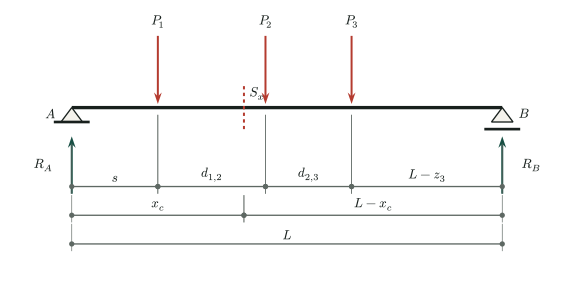
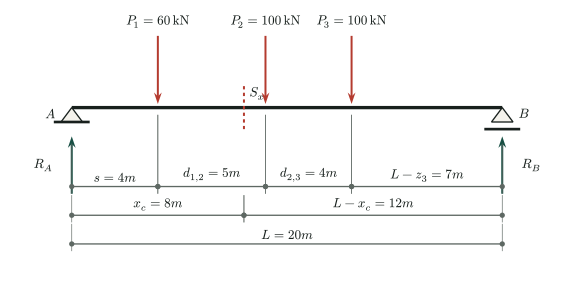
Consider a simply supported beam of span \(L\) subjected to three moving concentrated loads \(P_1\), \(P_2\), and \(P_3\) that move together without changing their intermediate spacings \(d_{1,2}\) and \(d_{2,3}\), as shown in the figure. The position \(s\) is used as a reference for locating the vehicle. The position \(z_1\) of the first load is assumed to coincide with \(s\); the other positions \(z_2\) and \(z_3\) are determined by the fixed spacings between the loads.
or, more generally,
- \(L\)
- Beam span
- \(x_c\)
- beams.theory.
- \(P_j\)
- Magnitude of the concentrated load \(j\)
- \(z_j\)
- Position of the concentrated load \(j\)
- \(d_{j,j+1}\)
- Distance between consecutive concentrated loads \(j\) and \(j+1\)
- \(R_A, R_B\)
- Upward support reactions
Downward concentrated loads and upward support reactions are positive.
3
Support reactions
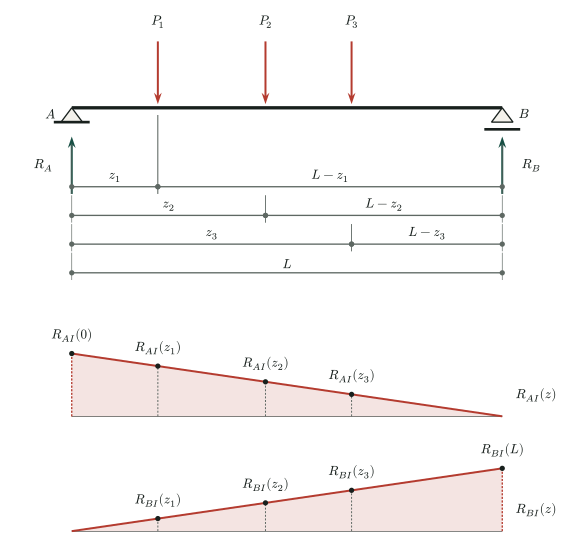
To determine the support reactions due to all concentrated loads of magnitude \(P_j\) located on the beam, it is convenient to use influence lines together with the principle of superposition.
Review the theory regarding the support reaction influence lines.
By the principle of superposition, the total support reactions \(R_A(s)\) or \(R_B(s)\) of a structure subjected to several loads can be found by summing the contributions of the individual loads: multiply the value \(P_j\) of each load \(j\) by the corresponding influence-line ordinate \(R_{AI}(z_j(s))\) or \(R_{BI}(z_j(s))\) evaluated at the load's position \(z_j(s)\), and add the different contributions. Influence-line ordinates outside the beam are taken to be zero (that is, \(R_{AI}(z_j(s))=0\) and \(R_{BI}(z_j(s))=0\) when \(z_j(s) < 0\) or \(z_j(s) > L\)).
or, more generally, for an arbitrary number \(n_P\) of concentrated loads,
4
Shear force
As with the support reactions, the shear force at section \(S_x\) fixed at position \(x_c\) due to all the concentrated loads of magnitude \(P_j\) on the beam is determined using influence lines and the principle of superposition.
Review the theory regarding the shear force influence lines.
A load left of section \(S_x\) gives a negative shear ordinate; a load right of it gives a positive one.
The total shear force \(V(s)\) due to several loads can then be determined using the principle of superposition: multiply the magnitude \(P_j\) of each load \(j\) by the corresponding influence-line ordinate \(V_I(z_j(s))\) evaluated at the load's position \(z_j(s)\), and sum the contributions. Influence-line ordinates outside the beam are taken to be zero (that is, \(V_I(z_j(s))=0\) when \(z_j(s) < 0\) or \(z_j(s) > L\)).
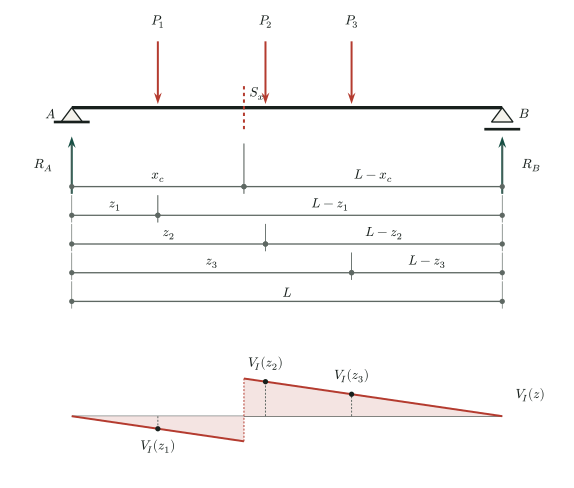
When any load \(j\) moves along the beam and passes the position \(x_c\) of the fixed section \(S_x\), the shear force changes abruptly because the influence line is discontinuous. When the point load is exactly at the section, the shear force is therefore ambiguous. In this case, consider the two one-sided influence-line values separately: \(V_I(z_j=x_c^-)\) to the left and \(V_I(z_j=x_c^+)\) to the right of the section. This gives two distinct values of the total shear force \(V(s)\): \(V_{min}(s)=V(s^-)\) with load \(j\) immediately to the left, and \(V_{max}(s)=V(s^+)\) with load \(j\) immediately to the right of the fixed section.
5
Bending moment
As with the shear force, the bending moment at section \(S_x\) fixed at position \(x_c\) due to all the concentrated loads of magnitude \(P_j\) on the beam is determined using influence lines and the principle of superposition.
Review the theory regarding the bending moment influence lines.
The bending-moment influence line is continuous and triangular. Its ordinate is zero at the supports, positive for a downward load inside the span, and greatest when the load is at section \(S_x\). Positive bending moment puts the lower fibers in tension.
The total bending moment \(M(s)\) due to several loads follows from superposition: multiply the magnitude \(P_j\) of each load \(j\) by the moment influence-line ordinate \(M_I(z_j(s))\) at its position \(z_j(s)\), and sum the contributions. Ordinates outside the beam are zero (that is, \(M_I(z_j(s))=0\) when \(z_j(s) < 0\) or \(z_j(s) > L\)).
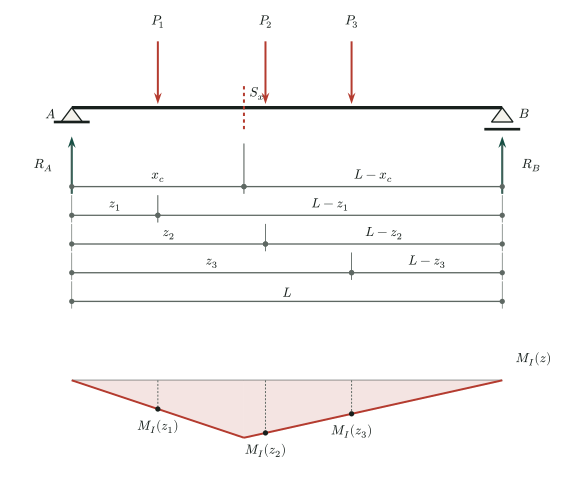
Unlike the shear force, the bending moment remains continuous when a load crosses the fixed section \(S_x\). The two branches of the influence line meet at \(z_j=x_c\), so a load exactly at the section has a single, well-defined moment ordinate; no one-sided values are needed.
6
Generalization for any type of response
To generalize the influence-line functions for the support reactions \(R_{{AI}}(z)\) and \(R_{{BI}}(z)\), shear force \(V_I(z)\), and bending moment \(M_I(z)\) associated with a single load at position \(z\), define a generic function \(f_I(z)\) that can represent any of these functions as needed (that is, \(f_I(z)=R_{{AI}}(z)\), \(f_I(z)=R_{{BI}}(z)\), \(f_I(z)=V_I(z)\), or \(f_I(z)=M_I(z)\), as appropriate).
Likewise, for the total responses of the support reactions \(R_A(s)\) and \(R_B(s)\), shear force \(V(s)\), and bending moment \(M(s)\) due to several concentrated loads of magnitude \(P_j\) positioned relative to the reference distance \(s\), define a general response function \(F(s)\) that can represent any of these responses as needed (that is, \(F(s)=R_A(s)\), \(F(s)=R_B(s)\), \(F(s)=V(s)\), or \(F(s)=M(s)\), as appropriate).
By the principle of superposition, the total response of a structure subjected to multiple loads is the sum of the individual contributions: multiply each load by the influence-line ordinate at its position and add the three contributions. Influence-line ordinates outside the beam are taken to be zero (that is, \(f_I(z)=0\) for \(z < 0\) or \(z > L\)).
or, more generally, for an arbitrary number \(n_P\) of concentrated loads,
7
Worked example at one position
At this one vehicle position, compute the reactions and the internal forces at the fixed section. This is not a maximum over all positions.
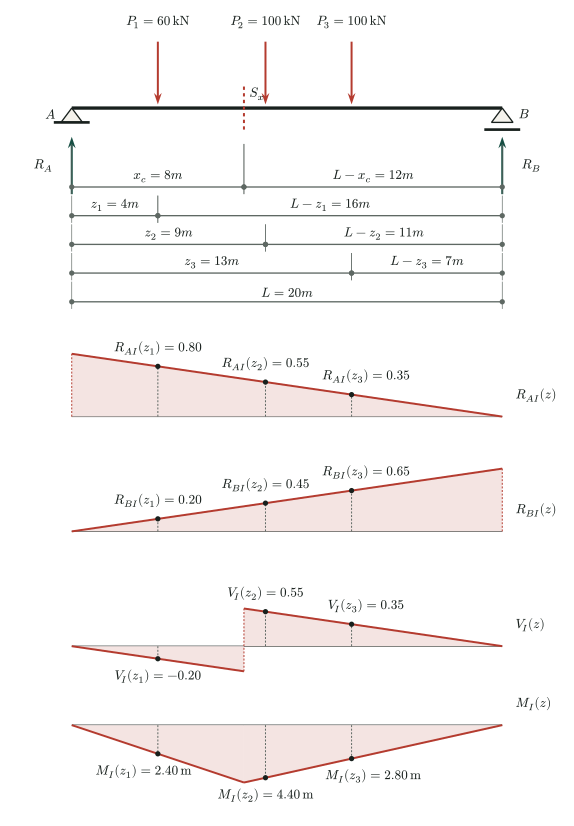
Support reactions
Shear force
Bending moment
Check the reactions by vertical equilibrium, then check shear and moment using the left free body:
8
Checks and limitations
For other vehicle positions, change \(s\) while holding the spacings fixed and reevaluate each ordinate. At a support crossing, a load starts or stops contributing; at a section crossing, use the appropriate one-sided shear value.
This example treats one position only. Finding a maximum or minimum requires evaluating the permitted positions and relevant load arrangements; confirm the actual design rules separately.
In this vertical-load beam model, axial force is zero. Horizontal actions, torsion, and local wheel-load effects need additional models.